- Jarod Kintz1537
- Beryl Dov878
- Debasish Mridha771
- Steve Maraboli285
- Cassandra Clare242
- Stephen Richards242
- J.K. Rowling215
- Oscar Wilde180
- John Green177
- Paulo Coelho176
- Rick Riordan153
- Criss Jami151
- C.S. Lewis142
- Nicholas Sparks142
- Albert Einstein141
- William Shakespeare135
- Friedrich Nietzsche129
- C. JoyBell C.128
- Stephen King127
- Mark Twain125
- Terry Pratchett117
- Ralph Waldo Emerson116
- Neil Gaiman114
- Richelle Mead109
- Haruki Murakami98
- Toba Beta95
- Rumi94
- Suzanne Collins94
- Amy Leigh Mercree91
- Lailah Gifty Akita91
- Shannon L. Alder88
- Santosh Kalwar87
- Jodi Picoult86
- Jane Austen84
- Kurt Vonnegut81
- Sarah Dessen81
- Carl Sagan80
- Jaachynma N.E. Agu79
- Chuck Palahniuk78
- Anonymous77
- T.F. Hodge77
- Maya Angelou76
- Virginia Woolf75
- Douglas Adams74
- Mahatma Gandhi74
- Albert Camus72
- Charles Bukowski72
- Leo Tolstoy72
- Mitch Albom71
- Amit Ray70
- Henry David Thoreau70
- Ray Bradbury66
- Sylvia Plath66
- Kahlil Gibran65
- Elizabeth Gilbert63
- Ernest Hemingway62
- Veronica Roth62
- Victor Hugo62
- Emily Dickinson61
- J.R.R. Tolkien61
- Suzy Kassem59
- Bill Watterson57
- George Carlin57
- Plato57
- Abraham Lincoln56
- Jim Butcher56
- Ayn Rand54
- Lemony Snicket54
- Steve Backley54
- Anaïs Nin53
- G.K. Chesterton53
- Dr. Seuss52
- Edgar Allan Poe51
- Colleen Houck50
- Johann Wolfgang von Goethe49
- Jonathan Safran Foer49
- Lisa Kleypas49
- Marilyn Monroe49
- George Bernard Shaw48
- F. Scott Fitzgerald47
- Martin Luther King Jr.47
- Markus Zusak46
- Bertrand Russell45
- Charlotte Brontë44
- Confucius44
- Lao Tzu44
- Lauren Oliver44
- Voltaire44
- Aristotle43
- Brian Tracy43
- David Levithan43
- Helen Keller43
- Jeaniene Frost43
- Marcus Aurelius43
- Margaret Atwood43
- Robert Frost43
- Stephen Chbosky43
- Winston S. Churchill43
- Charles Dickens42
- Rachel Caine42
No authors found.
Show morePick an author to see their quotes.
Bertrand Russell Quotes: 45
Man needs, for his happiness, not only the enjoyment of this or that, but hope and enterprise and change.
The good life is one inspired by love and guided by knowledge.
Extreme hopes are born from extreme misery.
There are two motives for reading a book; one, that you enjoy it; the other, that you can boast about it.
Those who have never known the deep intimacy and the intense companionship of mutual love have missed the best thing that life has to give.
The Conquest of HappinessOf all forms of caution, caution in love is perhaps the most fatal to true happiness.
Do not fear to be eccentric in opinion, for every opinion now accepted was once eccentric.
To fear love is to fear life, and those who fear life are already 3-parts dead.
I would never die for my beliefs because I might be wrong.
And if there were a God, I think it very unlikely that He would have such an uneasy vanity as to be offended by those who doubt His existence
Why I Am Not a Christian and Other Essays on Religion and Related SubjectsI do not pretend to be able to prove that there is no God. I equally cannot prove that Satan is a fiction. The Christian god may exist; so may the gods of Olympus, or of ancient Egypt, or of Babylon. But no one of these hypotheses is more probable than any other: they lie outside the region of even probable knowledge, and therefore there is no reason to consider any of them.
The Philosophy of Logical AtomismMy desire and wish is that the things I start with should be so obvious that you wonder why I spend my time stating them. This is what I aim at because the point of philosophy is to start with something so simple as not to seem worth stating, and to end with something so paradoxical that no one will believe it.
New Hopes for a Changing WorldOur great democracies still tend to think that a stupid man is more likely to be honest than a clever man, and our politicians take advantage of this prejudice by pretending to be even more stupid than nature made them.
A History of Western PhilosophyTo teach how to live without certainty, and yet without being paralyzed by hesitation, is perhaps the chief thing that philosophy, in our age, can still do for those who study it.
Those who have never known the deep intimacy and the intense companionship of happy mutual love have missed the best thing that life has to give.
We know very little, and yet it is astonishing that we know so much, and still more astonishing that so little knowledge can give us so much power.
The Impact of Science on SocietyReally high-minded people are indifferent to happiness, especially other people's.
The secret of happiness is to face the fact that the world is horrible, horrible, horrible.
What I BelieveEven if the open windows of science at first make us shiver after the cozy indoor warmth of traditional humanizing myths, in the end the fresh air brings vigor, and the great spaces have a splendor of their own.
Anything you're good at contributes to happiness.
What is wanted is not the will to believe, but the will to find out, which is the exact opposite.
Science is what you know, philosophy is what you don't know
It is essential to happiness that our way of living should spring from our own deep impulses and not from the accidental tastes and desires of those who happen to be our neighbors, or even our relations.
A History of Western PhilosophyAlmost everything that distinguishes the modern world from earlier centuries is attibutable to science, which achieved its most spectacular triumphs in the seventeenth century.
Why I Am Not a Christian and Other Essays on Religion and Related SubjectsScience can teach us, and I think our hearts can teach us, no longer to look around for imaginary supporters, no longer to invent allies in the sky, but rather to look to our own efforts here below to make the world a fit place to live.
Remember your humanity, and forget the rest.
To like many people spontaneously and without effort is perhaps the greatest of all sources of personal happiness.
The Impact of Science on SocietyAristotle maintained that women have fewer teeth than men; although he was twice married, it never occurred to him to verify this statement by examining his wives' mouths.
The Problems of PhilosophyIs there any knowledge in the world which is so certain that no reasonable man could doubt it?
The whole problem with the world is that fools and fanatics are always so certain of themselves, and wiser people so full of doubts.
It is not what the man of science believes that distinguishes him, but how and why he believes it. His beliefs are tentative, not dogmatic; they are based on evidence, not on authority or intuition.
The Problems of PhilosophyWhoever wishes to become a philosopher must learn not to be frightened by absurdities.
Our Knowledge of the External WorldPhilosophy, from the earliest times, has made greater claims, and achieved fewer results, than any other branch of learning.
To fear love is to fear life, and those who fear life are already three parts dead.
The world is full of magical things patiently waiting for our wits to grow sharper.
A History of Western PhilosophyThe search for something permanent is one of the deepest of the instincts leading men to philosophy.
Never let yourself be diverted, either by what you wish to believe, or what you think could have beneficent social effects if it were believed; but look only and solely at what are the facts.
The Problems of PhilosophyThe man who has no tincture of philosophy goes through life imprisoned in the prejudices derived from common sense, from the habitual beliefs of his age or his nation, and from convictions which have grown up in his mind without the cooperation or consent of his deliberate reason.
A History of Western PhilosophyWilliam James describes a man who got the experience from laughing-gas; whenever he was under its influence, he knew the secret of the universe, but when he came to, he had forgotten it. At last, with immense effort, he wrote down the secret before the vision had faded. When completely recovered, he rushed to see what he had written. It was: "A smell of petroleum prevails throughout.
There lies before us, if we choose, continual progress in happiness, knowledge and wisdom. Shall we instead choose death, because we cannot forget our quarrels? I appeal as a human being to human beings; remember your humanity, and forget the rest.
La Ciencia en ningún momento está totalmente en lo cierto, pero rara vez está completamente equivocada y tiene en general mayores posibilidades de estar en lo cierto que las teorías no científicas.
Why I Am Not a Christian and Other Essays on Religion and Related SubjectsThe Victorian Age, for all its humbug, was a period of rapid progress, because men were dominated by hope rather than fear. If we are again to have progress, we must again be dominated by hope.
Introduction to Mathematical PhilosophyThe method of 'postulating' what we want has many advantages ; they are the same as the advantages of theft over honest toil.
It is evident as a matter of logic that, since they (world religions) disagree, not more than one of them can be true.
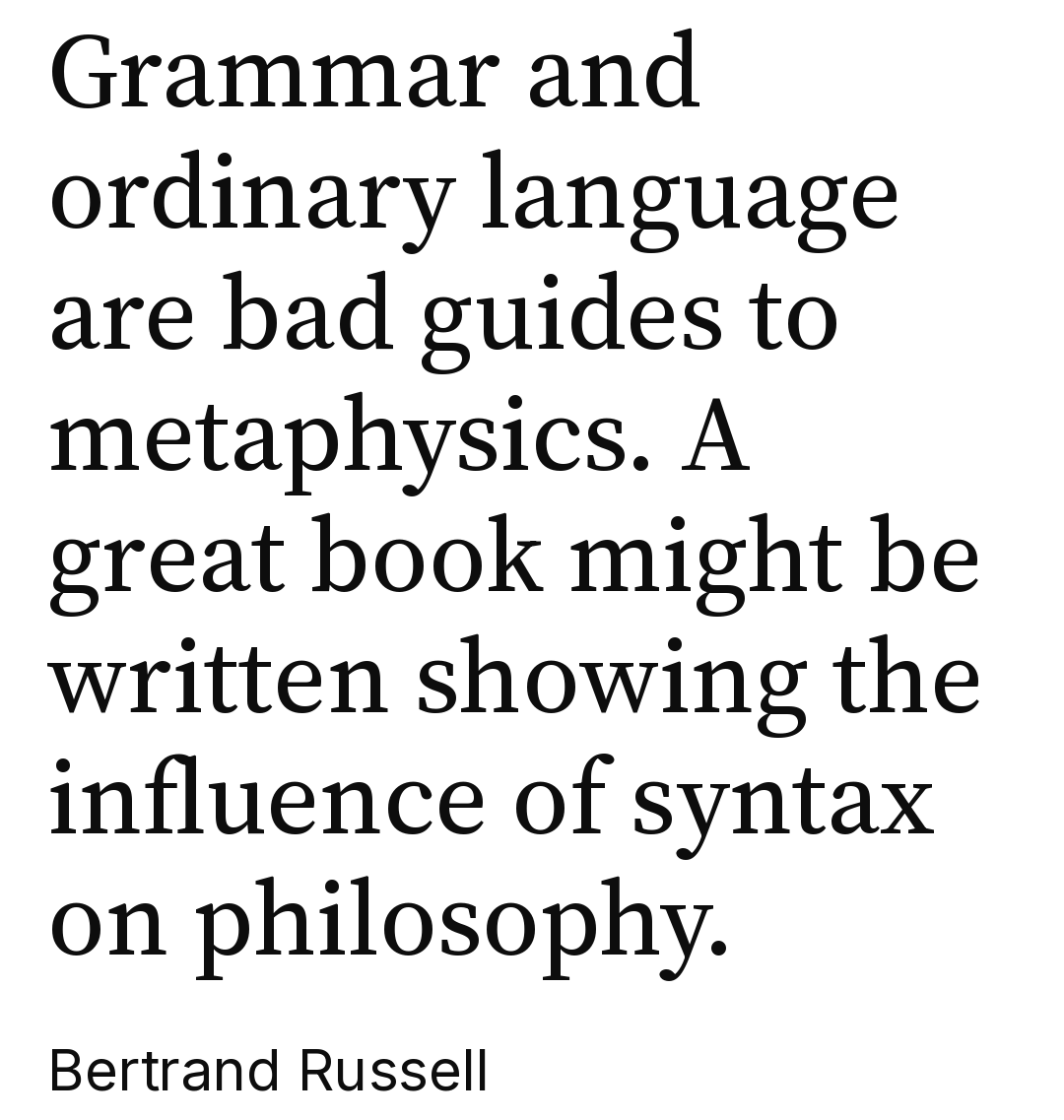
Grammar and ordinary language are bad guides to metaphysics. A great book might be written showing the influence of syntax on philosophy.